

Description
What Is Coke Dust and Why Does It Matter
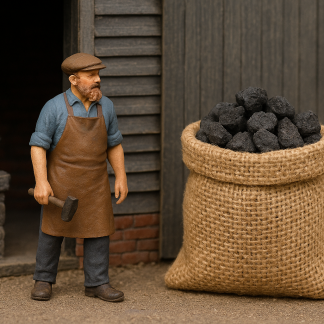
Coke dust is a byproduct of coke—a solid carbon-rich material derived from coal. While coal burns with smoke and impurities, coke burns cleaner and hotter, making it ideal for blast furnaces and steam locomotives. When coke is crushed, transported, or stored, it produces a fine black powder: coke dust.
This fine material accumulates around coaling towers, blast furnaces, and engine servicing facilities. Historically, coke dust covered the ground beneath water towers, fuel bunkers, and ash pits. It stained the ballast, dirt, and surrounding buildings. For modelers, it’s essential for capturing the true texture and tone of heavy industry in the steam era.
Using Coke Dust in a Model Railroad Layout
You can apply coke dust in various ways depending on the scene you’re building. For most applications, gently sprinkle it over white glue or matte medium. Mist with water and isopropyl alcohol to fix the particles in place. You can also mix coke dust with darker powders to create custom blends for soot-covered ground cover.
In HO scale, coke dust looks like fine grime. In N scale, it resembles chunks of ash or powdered fuel. In O scale, it can be used in layers to deepen visual texture. Because it is real carbon dust, not dyed foam, it reflects light more realistically and never fades.
Coke Dust Around Coaling Towers
Steam locomotives required regular fuel and water. Every few hundred miles, engines stopped at coaling stations. These facilities featured vertical towers that dumped coke or coal into tenders. As the coke was handled and spilled, dust coated the ground and rails.
Reproducing this effect gives your coaling tower scene authenticity. Apply coke dust beneath the tower, along the service tracks, and around worker pathways. Dust should be heaviest near loading zones and fade outward. To increase realism, blend in 1210 Paving Powder or 1220 Ash Pit Gray to create layers of weathered soot.
Engine Service Facilities and Ash Pits
In addition to fueling, steam locomotives also needed to dump their ashes. This occurred in ash pits, which often had cinder, coal, and coke residue built up over time. Coke dust can be applied here to simulate recent dumping or to blacken the trackside terrain.
In roundhouse areas, you’ll often see layers of grime near inspection pits and service walkways. Coke dust helps tie these features together. Transition the coke into ballast textures or bare soil with lighter powders like 1103 Low Desert Soil or 1222 Yard Mix.
Steel Mills, Foundries, and Coke Ovens
Beyond railroads, coke dust plays a central role in modeling steel production. Steel mills use coke as a fuel and chemical reducing agent. The raw coke is stored in large piles, and the surrounding areas are covered in black residue. Use coke dust to weather the ground, track, and buildings.
If you’re modeling a coke oven battery or blast furnace, lay down thick bands of coke dust in traffic paths. These should include areas where coke was loaded into rail cars or dumped into hoppers. Pair with materials like 1124 Coke (chunk) to simulate unburned residue.
Modern Uses in Weathering Freight Cars
Although coke usage declined with the diesel era, its legacy remains visible. You can use coke dust as a pigment for weathering freight cars, gondolas, or tankers. Mix the powder into alcohol or thinned matte medium and brush it on panels to simulate built-up grime.
Another option is dry-brushing coke dust around fuel caps, vents, underframes, and bogies. The powder settles into corners and details, adding realism and contrast. Use this technique sparingly for a natural look. It pairs especially well with weathering powders like Black Cinder, Gray Granite, or Roofing Sand.
What Railroads Used Coke?
Coke was widely used across North America in steel-producing regions. The Pennsylvania Railroad, Baltimore & Ohio, and New York Central all serviced coke-producing zones. Railroads in Appalachia and the Midwest routinely hauled coke to steel mills in Pittsburgh, Youngstown, and Gary.
In the West, the Denver & Rio Grande Western and Union Pacific also moved coke into mining towns and industrial centers. Modeling these lines requires attention to fuel infrastructure, and coke dust offers an easy way to indicate industrial presence.
Even Canadian railroads like Canadian National and CP Rail serviced coke plants near Sudbury and Hamilton. Coke’s influence spans both time and geography.
What the Rock Actually Is
Coke is not a natural stone. It’s a fuel manufactured by baking coal at high temperatures in sealed ovens. This process drives off impurities and leaves behind nearly pure carbon. Once cooled, coke is hard and porous—ideal for high-temperature applications.
Our coke dust comes from real coke, not dyed material. We crush it into fine powder and screen it carefully to remove oversize particles. Unlike synthetic scenery materials, real coke reflects light naturally and settles into terrain realistically. It has no artificial shine or static cling.
That’s why modelers trust our 1120 Bag Coke Dust to deliver a true-to-life finish.
Available Sizes and Packaging
We offer 1120 Coke Dust in two weight options:
- 12oz Bag – Recommended for small scenes, detailing work, or mixing into custom blends.
- 1lb Bag – Ideal for larger layouts, heavy weathering, and steel mill dioramas.
Both sizes come sealed in labeled bags for easy storage. The powder is screened and ready to use out of the bag—no processing needed. Shake gently before use to release any compaction.
Why You Need to Buy This
Coke dust is essential for any modeler working in the steam or early diesel eras. It provides realism that plastic or foam can’t match. Whether you’re detailing a steel mill, a coaling stage, or a yard throat, coke dust finishes the scene.
Without coke dust, service areas look too clean. Industrial railroads lacked cleanliness, especially during the era of steam. Soot, dust, and grime were everywhere. Coke dust allows you to recreate that texture, grounding your layout in history and reality.
You’ll also find that it enhances photos and videos. The soft black powder absorbs light and prevents glare. It allows fine details to stand out against the weathered backdrop. It’s a must-have for contests, club layouts, or personal builds.
Best Materials to Use With Coke Dust
To get the most out of your coke dust, pair it with these companion products:
- 1124 Bag Coke (chunk) – Layered texture, especially for loading scenes
- 1220 Ash Pit Gray – To transition between ballast and ash dumps
- 1210 Paving Powder – Works as adjacent road or cinder base
- 1284 Smooth Rock Powder – For weathered contrast or mixing into yard textures
- 1050 CSX Powder – A darker cinder base that blends well with coke dust
- Gray Granite or White Marble powders – Used for contrasting lighter colors
These combinations will give you depth and control over how grime accumulates and fades in your scenes.
Safety and Application Tips
Although it’s non-toxic, coke dust is still a fine particulate. Avoid breathing the dust directly. Use a dust mask if working in confined areas. Mist with water or alcohol before final adjustment to prevent particles from spreading.
Always apply coke dust before sealing the scene with matte medium. Test small areas first to control coverage. Once sealed, the coke dust becomes a permanent part of the landscape and can be brushed or painted over without shifting.
Keep it out of reach of children or pets. Store sealed in a cool, dry place.
Real Customer Uses and Layout Examples
We’ve seen customers use 1120 Bag Coke Dust in a variety of impressive ways:
- A steam-era roundhouse in Missouri featuring coke piles and blackened ballast
- A steel mill diorama in N scale with coke loading hoppers and blast furnaces
- A coaling stage scene with faded white ballast and dark soot layers beneath the tower
- A narrow-gauge mining layout with industrial coke ovens and rail-side residue
- A switching layout with a fueling pad blackened by coke dust runoff
Because this powder is so fine, it works even in small spaces. Use it under structures, around engines, or on engine service tracks to highlight realism.
How It Compares to Other Products
Some scenery brands offer black foam or dyed plastic powder. These alternatives look shiny or uniform. Our coke dust is made from real crushed coke, giving it a natural matte finish.
It doesn’t float or resist glue. Instead, it settles just like dirt would. Coke dust can be spread thin or thick depending on your needs. It also sticks well to vertical surfaces with a bit of matte medium.
Compared to cinders or dark soil, coke dust is finer and blacker. It works especially well when combined with coarser material like rocks or ballast.




Reviews
There are no reviews yet